
| Key Takeaways |
|
Creatine loading is one of those topics where everyone in the gym has a strong opinion and almost no one can tell you why.
One of the reasons it causes so much confusion is that both sides are technically right. The people telling you to load aren’t wrong. The people telling you to just take 5g a day aren’t wrong either. They simply get you to the same place at different speeds.
This guide covers what the research actually shows, what side effects are worth knowing about, and which approach makes most sense depending on where you are right now.
| In This Guide |
|
1. What creatine actually does in your muscles 2. What a creatine loading phase involves 3. Does creatine loading actually work? What the research shows 4. Creatine loading side effects 5. Loading vs no loading: which protocol is right for you? 6. How to take creatine: a clear UK protocol 7. Who gets the most from creatine supplementation? 8. FAQs |
What Creatine Actually Does in Your Muscles
Think of creatine as your muscles’ emergency energy reserve.
During a heavy set of squats, a sprint, or any short burst of intense effort, your body burns through its immediate energy supply — ATP — extremely quickly. We’re talking seconds. Creatine helps replenish that supply faster, allowing you to maintain intensity for a little longer before fatigue forces you to stop or drop the weight.
Over time, those extra reps add up. Better output per session, compounded across weeks and months, translates into measurably greater strength and lean muscle. That’s the mechanism. It’s not complicated, and it’s not magic, it just works.
Your body produces creatine naturally and you get small amounts from red meat and fish, but dietary intake alone rarely saturates your muscle stores fully. That’s where supplementation fills the gap.
A 2017 meta-analysis in Sports Medicine, pooling data from 22 controlled trials, confirmed creatine supplementation combined with resistance training produced significantly greater increases in maximum strength compared to training without supplementation. → Lanhers et al. 2017
What a Creatine Loading Phase Actually Involves
A standard loading protocol involves consuming 20g of creatine monohydrate per day, split into four servings of 5g spread throughout the day, for five to seven consecutive days. The aim is to saturate your muscle creatine stores as rapidly as possible — reaching the upper storage limit quickly rather than building towards it gradually over weeks.
After the loading phase, the standard recommendation is to drop to a maintenance dose of 3–5g per day. At this lower daily amount, the small quantity of creatine naturally broken down and excreted is replenished, keeping muscles fully saturated.
Does Creatine Loading Actually Work? What the Research Shows
Yes — loading works as a method of rapidly saturating muscle creatine stores. But no, it is not necessary to achieve the same long-term results as a steady lower-dose approach.
Speed vs outcome: Both approaches reach the same endpoint — fully saturated muscle creatine stores — but on different timelines. A loading protocol achieves saturation in approximately 5–7 days. A maintenance-only approach of 3–5g daily takes approximately 28 days to reach the same level. The end result is biologically identical; only the journey is different.
A simple way to think about it: Imagine two people starting creatine on the same day. Person A loads at 20g per day for a week. Person B takes 5g per day from day one. After that first week, Person A will likely have fully saturated muscle stores. Person B is still building towards saturation. Fast forward a month, and they’re effectively in the same place — same stores, same performance benefits, same results. The only real difference was the first few weeks.
If you have a competition, a fitness test, or a sporting event coming up soon and you want to be fully saturated before it arrives then load. If you’re supplementing as part of a long-term training routine with no specific deadline there’s no meaningful reason to.
| Protocol | Loading Phase | Daily Dose | Time to Full Saturation |
| With loading | 20g/day for 5–7 days | 3–5g/day after | 5–7 days |
| Without loading | None | 3–5g/day from day one | ~28 days |
A 2021 review in the Journal of the International Society of Sports Nutrition confirmed that once both approaches reached full saturation, strength, power, and lean mass outcomes were equivalent. Loading produced no additional benefit — it simply accelerated the timeline. → Antonia et al. 2021
A 2017 ISSN position paper confirmed that both protocols are valid, with loading recommended only for those needing rapid saturation for a specific performance deadline. → Kreider et al. 2017
Creatine Loading Side Effects: What You Should Know
Creatine monohydrate is one of the most extensively safety-tested supplements in sports science. The side effects most commonly associated with creatine are almost entirely tied to the loading phase, not to creatine supplementation in general.
Gastrointestinal discomfort:
The most commonly reported loading side effect is stomach cramping, bloating, and loose stools. This is a direct consequence of high single-dose intake. Taking 5g four times daily with food and plenty of water significantly reduces this risk. If your gut is sensitive, skipping the loading phase and going straight to 3–5g daily eliminates this side effect almost entirely.
Water retention and scale weight:
Creatine draws water into muscle cells as part of its mechanism of action — this is a sign it is working. During loading, the rapid increase in muscle creatine concentration typically produces a noticeable increase in scale weight of 1–2kg within the first week. This is intramuscular water, not fat.
The kidney myth:
If you’ve ever mentioned taking creatine to someone who doesn’t lift, there’s a good chance you’ve heard the kidney warning. The problem is that decades of research simply haven’t supported it in healthy individuals.
Multiple long-term studies in healthy adults have found no evidence of kidney damage from creatine supplementation at standard doses. The JISSN safety review found no adverse kidney effects at doses up to 30g per day over five years in healthy individuals. If you have pre-existing kidney disease, speak with your GP — but for healthy adults, the evidence is conclusive.
Loading vs No Loading: Which Protocol Is Right for You?
| Should You Load Creatine? Quick Decision Guide |
|
✓ Use a loading phase if:
✗ Skip loading and start at 3–5g/day if:
|
| What We’d Do at IW2B |
|
If you’re starting creatine for the first time, we’d skip the loading phase and take 3–5g daily from day one. Yes, loading works. But most people are supplementing for months or years rather than trying to peak for an event next week. The long-term result is identical, and the risk of bloating or stomach discomfort during that first week is simply not worth it for the majority of people. The exception is someone preparing for a competition, a fitness test, or a sporting event where getting fully saturated quickly genuinely matters. In that case, load — but split it across four 5g servings with food, and drink more water than you think you need. Otherwise: 5g a day, every day, including rest days. That’s it. |
One consistent recommendation regardless of protocol: stick with creatine monohydrate.
Creatine HCl, buffered creatine, and creatine ethyl ester are marketed as superior alternatives, but none has demonstrated better muscle saturation or performance outcomes in head-to-head comparisons. They cost considerably more and deliver no measurable advantage.
How to Take Creatine: A Clear UK Protocol
| Quick Creatine Protocol Guide |
|
Based on current ISSN evidence-based guidance
Option 1 — With Loading Phase (faster results) • Loading dose: 20g/day split into 4 × 5g servings, taken with food, for 5–7 days • Then maintenance: 3–5g per day ongoing • Full saturation: achieved in ~5–7 days
Option 2 — No Loading Phase (simpler, same result) • Daily dose: 3–5g per day from day one • Full saturation: achieved in ~28 days
For Both Protocols • Form: Creatine monohydrate only — no advantage to HCl, buffered, or ethyl ester variants • Timing: Any time of day — consistency matters more than the clock • Hydration: Aim for at least 2–2.5 litres of water per day while supplementing. Creatine pulls water into your muscle cells, so your total daily water needs increase, especially if you’re also hitting a high daily protein target. • Cycling: No need — continuous daily use is safe and effective
To calculate your maintenance dose: 0.03–0.05g × bodyweight (kg) per day. An 80kg person needs 2.4–4g daily to maintain saturation. |
If You’re Buying Creatine
The only form we’d currently recommend is creatine monohydrate.
It’s the form used in the overwhelming majority of research, it’s the most affordable option available, and it consistently outperforms the expensive alternatives marketed as ‘next generation’ creatine — HCl, buffered, ethyl ester. None of those have demonstrated better muscle saturation or performance outcomes in head-to-head comparisons with monohydrate. They’re just more expensive.
Unflavoured powder is the most practical option. It dissolves easily in water, a shake, or juice, and you’re not paying extra for flavourings you don’t need.
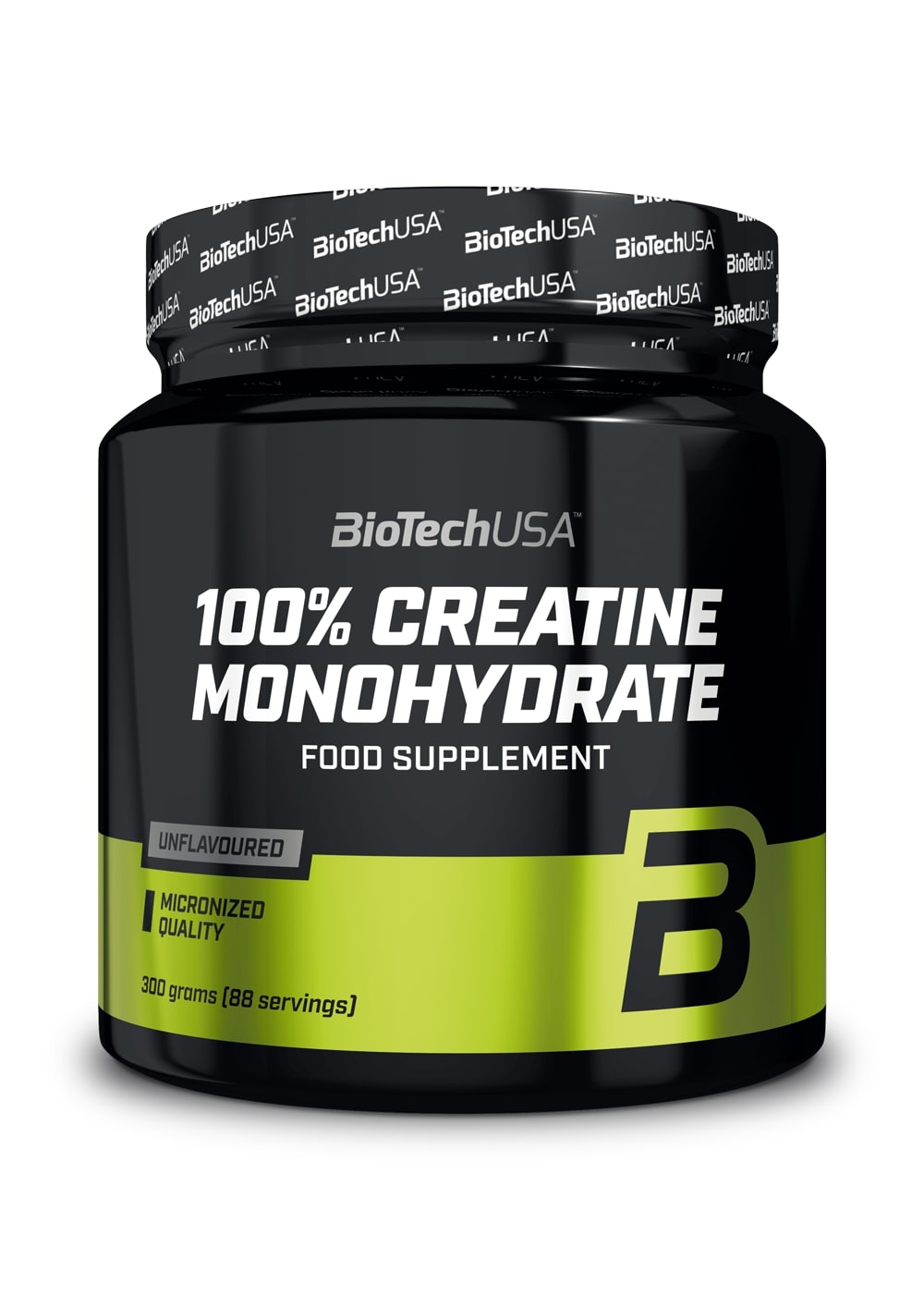
For anyone looking for a straightforward monohydrate option, we currently stock:
| BioTechUSA 100% Creatine Monohydrate, Unflavoured — 300g |
|
Pure creatine monohydrate with no additives, no fillers, and no inflated price tag for a trendy variant. Just the compound with decades of evidence behind it, in the dose that works. • Pure monohydrate — the evidence-based choice • Unflavoured — mixes into anything • From BioTechUSA, a trusted European sports nutrition brand
→ Shop BioTechUSA 100% Creatine Monohydrate at iwant2be.co.uk |
Who Gets the Most from Creatine Supplementation?
Creatine is effective across a wide range of training types and demographics, but the magnitude of benefit varies.
Vegetarians and vegans
Creatine is found naturally in meat and fish, so plant-based eaters typically have lower baseline muscle creatine stores and more room to benefit. Research consistently shows larger performance gains in vegetarians compared to omnivores when supplementing.
Older adults
A 2021 review in Nutrients found significant improvements in muscle strength and functional performance in older adults taking creatine alongside resistance training. → Forbes et al. older adults
Strength and power athletes
Creatine’s primary mechanism directly benefits activities requiring repeated short bursts of high-intensity effort — weightlifting, sprinting, HIIT, team sports. The research base is strongest here.
Creatine is often most effective when paired with a solid foundation of daily protein intake and a structured resistance training programme.
Non-responders
Roughly 25–30 percent of people see limited response to creatine — typically because their baseline muscle creatine stores are already near the upper range (most commonly seen in regular meat eaters). If you have taken creatine consistently for eight weeks and noticed no change, you may be in this group. It is not a quality issue — it reflects individual physiology… If that’s you, it’s worth trying a different brand once to rule out a batch issue but if nothing changes, your baseline stores are likely already where they need to be.
| Common Creatine Mistakes UK Gym-Goers Make |
|
Frequently Asked Questions
Do you need to load creatine to see results?
No. Loading accelerates the timeline to full muscle saturation but produces no better long-term result. Taking 3–5g of creatine monohydrate daily for 28 days produces the same fully saturated muscle creatine stores as a five-day loading phase.
Most recreational lifters can safely skip loading entirely without sacrificing any long-term benefit.
How long does creatine loading take to work?
A loading protocol saturates muscle creatine stores within 5–7 days. Performance improvements — more reps at a given weight, better recovery between sets — may be noticeable within the first week, along with a small increase in scale weight from intramuscular water. Without loading, the full effect builds over approximately 28 days.
What happens if you miss a day of creatine?
Nothing significant. Muscle creatine stores deplete slowly — it takes several weeks of not supplementing to return to baseline. Simply resume your normal daily dose.
Is creatine safe to take every day long term?
Yes. Creatine monohydrate has been studied in both short and long-term settings for decades. Studies following participants supplementing daily for up to five years found no adverse effects on kidney or liver function in healthy adults. If you have existing kidney disease or take prescription medication, check with your GP before starting.
Does creatine cause weight gain?
Yes, but not fat gain. Creatine causes an increase in scale weight due to water being drawn into muscle cells — typically 1–2kg during the first one to two weeks. This is intramuscular water, not fat.
Should I take creatine before or after training?
Timing has minimal effect on outcomes. Consistent daily intake to maintain muscle saturation is what matters. Some research suggests a slight edge to post-workout consumption, but the effect is small. The most practical approach is taking it at the same time each day.
Can women take creatine?
Yes. Women respond similarly to men in terms of performance and strength benefits from creatine. The same dosing guidelines apply. The water retention effect is present in women too, though often more pronounced in men due to greater total muscle mass.
Which form of creatine is best?
Creatine monohydrate. It is the most studied, the most effective, and by some margin the most cost-efficient form available. Creatine HCl, buffered creatine (Kre-Alkalyn), and creatine ethyl ester are all marketed as superior options, but none has demonstrated better muscle saturation or performance outcomes in controlled comparisons with monohydrate.
Continue Reading: More From the Stronger & Leaner Hub
Creatine can help you squeeze more from your training, but it won’t compensate for poor nutrition, inconsistent workouts, or inadequate protein intake. Start with the fundamentals, then use supplements to support them.
- How Much Protein Do You Actually Need to Build Muscle?
- Best Pre-Workout Supplements UK (Tested & Ranked) — coming shortly to the hub
- Whey vs Casein vs Isolate: Which Protein Powder Is Right for You? — coming shortly to the hub
For everything else on building strength and lean muscle the smart way, the Stronger & Leaner hub is the place to start.