
|
Key Takeaways • Caffeine, beta-alanine, and citrulline malate are the three ingredients with the strongest research support • Effective doses matter more than the ingredient list — always check the gram amounts • Proprietary blends that hide individual quantities are a red flag worth avoiding • Timing matters less than people think — take it 20–30 minutes before training and move on • Pre-workout is a performance tool, not a substitute for sleep, food, or consistent training • Evening trainers: stimulant-free options still deliver the citrulline and beta-alanine benefits without disrupting sleep |
Walk into any Boots, Holland & Barrett, or sports nutrition retailer in the UK and the pre-workout shelf is overwhelming. Dozens of products, aggressive branding, proprietary blends that tell you very little, and ingredient lists long enough to require a biochemistry degree to parse.
The honest answer is that most pre-workouts work — but not equally, and not entirely for the reasons their marketing suggests. The real performance benefits come from a handful of well-researched ingredients. Everything else in the formula is either supporting cast or filler.
If you understand what those key ingredients do and what doses are actually effective, you can cut through the noise entirely. This guide covers the science, the numbers, what to avoid, and how to use a pre-workout intelligently as part of a complete training approach.
|
In This Guide 1. Do pre-workout supplements actually work? 2. The core ingredients: what works and what does not 3. What to avoid in a pre-workout 4. How to use pre-workout supplements intelligently 5. Pre-workout for beginners: where to start 6. Stacking pre-workout with other supplements 7. Frequently asked questions |
Do Pre-Workout Supplements Actually Work?
Yes — but the effect is ingredient-dependent, dose-dependent, and context-dependent. Pre-workouts are not magic. They do not replace adequate sleep, consistent training, or proper nutrition. What the well-evidenced ingredients in a quality formula do is provide a meaningful, measurable edge: more alertness, more power output, better endurance within a session, and faster recovery between sets.
A 2016 study published in the Journal of the International Society of Sports Nutrition found that acute ingestion of a multi-ingredient pre-workout supplement produced significantly more reps to failure on bench press, improved mean power output during sprint testing, and significantly improved subjective markers of fatigue and alertness compared to placebo — with caffeine identified as the primary active driver of the acute effect (Jagim et al., 2016).
The products that underperform are typically either underdosed — using the right ingredients at fractions of the effective amounts to keep costs down — or relying on proprietary blends that hide individual quantities entirely. Understanding effective doses is the single most useful thing you can know when evaluating any pre-workout.
The Core Ingredients: What Works and What Does Not
|
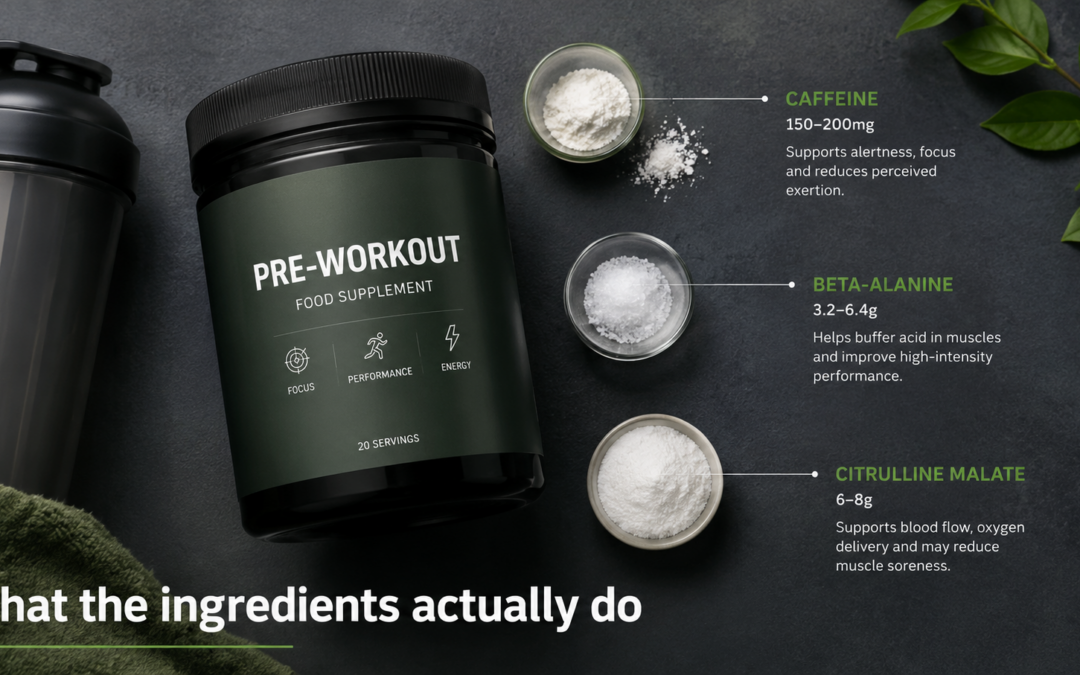
Quick Reference: Effective Doses Caffeine — 3–6mg per kg bodyweight | 150–300mg typical serving | 30–60 min before training Beta-Alanine — 3.2–6.4g per day | Daily supplementation more important than timing Citrulline Malate — 6–8g per serving | Check the actual gram amount, not just the name on label Creatine (if included) — 5g daily (take separately on rest days too for consistency) |
A product containing all three ingredients at effective doses will usually outperform a product with twenty ingredients included at ineffective amounts.
Caffeine: The Foundation
Caffeine is the single most evidence-backed performance ingredient in sports nutrition. It works by blocking adenosine receptors in the brain, reducing perceived effort and fatigue, and stimulating the central nervous system to increase power output and endurance.
An umbrella review of 21 published meta-analyses in the British Journal of Sports Medicine, drawing on the full body of caffeine and exercise research available at the time, concluded that caffeine consistently improves endurance performance, strength, power, and speed. The performance benefit across exercise types averaged approximately 2–3% — which translates directly into more reps, heavier lifts, and faster times in a real training session (Grgic et al., 2020).
Effective dose: 3–6mg per kg of bodyweight, consumed 30–60 minutes before training. For an 80kg person, that is 240–480mg. Most quality pre-workouts sit at 150–300mg per serving, which covers this range well.
If you have been drinking three coffees a day for years, do not expect a 200mg pre-workout to hit the same way it hits someone who rarely touches caffeine. Tolerance builds through consistent exposure, and the adenosine receptors that caffeine blocks become less sensitive over time. A two-week break from all caffeine (coffee, tea, energy drinks) before starting a new product resets that baseline significantly.
Beta-Alanine: The Endurance Buffer
Beta-alanine is converted in the body to carnosine, which buffers lactic acid in muscle tissue during high-intensity exercise. Higher muscle carnosine concentrations delay the onset of the burning sensation that forces you to stop a set — meaning more reps before failure and better endurance in efforts lasting 1–4 minutes.
A 2012 meta-analysis in Amino Acids, covering 15 published studies and 360 participants, confirmed that beta-alanine significantly improved exercise performance in activities lasting 60–240 seconds — exactly the duration of most working sets in resistance training (Hobson et al., 2012 — PMC3374095).
Effective dose: 3.2–6.4g per day. Because carnosine builds in muscle over time, daily supplementation matters more than pre-workout timing.
The tingling (paraesthesia) beta-alanine causes — most noticeable in the face, neck, and hands — is harmless and temporary. It is simply a nerve response to the compound. Split dosing (two smaller doses across the day) reduces the intensity if it bothers you.
Citrulline Malate: The Pump and Endurance Compound
Citrulline is an amino acid that increases plasma arginine levels, boosting nitric oxide production. More nitric oxide means greater vasodilation — wider blood vessels — which improves blood flow to working muscles, enhances oxygen and nutrient delivery, and produces the pump effect most lifters associate with a productive session.
A 2010 study in the Journal of Strength and Conditioning Research found that 8g of citrulline malate consumed 60 minutes before training significantly increased the number of reps performed to failure across multiple upper-body exercises, with participants also reporting lower muscle soreness 24 and 48 hours post-training (Perez-Guisado & Jakeman, 2010).
Effective dose: 6–8g of citrulline malate per serving. Many pre-workouts include citrulline on the label at 1–2g — well below the effective threshold. Always check the actual gram amount, not just the ingredient name.
Creatine in Pre-Workouts: Useful or Redundant?
Some pre-workouts include creatine monohydrate. If you are already taking creatine separately — as covered in our creatine loading guide — the additional 1–3g in a pre-workout is generally too low to move the needle on your daily total.
If you are not taking creatine separately and the pre-workout contains a full 5g serving, it can serve double duty. The caveat: pre-workouts are only taken on training days. Consistent daily creatine — including rest days — is what drives results, so relying solely on a pre-workout for your creatine dose means gaps in your protocol.
What to Avoid in a Pre-Workout
Knowing what to look for is only half the picture. These are the red flags worth recognising:
- Proprietary blends: Any formula that lists ingredients under a collective ‘blend’ total without individual amounts makes it impossible to verify whether you are getting effective doses. This is a common way to include impressive-sounding ingredients at sub-effective quantities while keeping manufacturing costs low.
- Extremely high caffeine doses: Products exceeding 300mg of caffeine per serving offer little additional performance benefit and significantly increase the risk of anxiety, jitteriness, elevated heart rate, and post-session crashes. Some products on the market exceed 400mg per serving — approach with caution.
- Stimulant cocktails: Pre-workouts containing multiple stimulants beyond caffeine — synephrine, DMHA, and similar compounds — carry genuine health risks and some have been subject to regulatory action in the UK and EU. DMHA in particular has been flagged by the Food Standards Agency. If the energy effect feels unusually intense or causes palpitations, scrutinise the ingredient panel carefully.
- Excessive sugar: Some entry-level pre-workouts use large amounts of simple carbohydrates for energy. Not inherently harmful, but better sourced from your diet, and the sugar can be counterproductive for those managing body composition.
How to Use Pre-Workout Supplements Intelligently
Pre-workouts are a session tool. Used well they give you a consistent edge; used carelessly they erode sleep and build dependency.
Most people spend far too much time debating whether to take their pre-workout 20 minutes or 35 minutes before training. The difference is negligible compared with simply getting enough sleep the night before.
- Timing: Take 20–30 minutes before training. Caffeine peaks in plasma at approximately 45–60 minutes post-ingestion, so this window aligns your warm-up and early sets with the onset of the stimulant effect.
- Cut-off time: Caffeine has a half-life of approximately five to six hours. A 200mg pre-workout taken at 6pm means approximately 100mg of caffeine is still in your system at 11pm. For most UK gym-goers with a standard sleep schedule, an afternoon cut-off of no later than 4–5pm is sensible. For evening training, look for stimulant-free options — citrulline and beta-alanine still deliver performance benefits without the caffeine.
- Do not use every session: Using a pre-workout for every session, including light recovery days, accelerates tolerance and reduces the effect when you actually need it. Reserve pre-workouts for your heaviest or most demanding sessions.
- Assess your total caffeine intake: Add your daily coffee, tea, and any other caffeine sources to your pre-workout dose before evaluating total intake. The NHS recommended upper intake is 400mg per day for healthy adults. A triple-shot coffee before a 250mg pre-workout is pushing that limit.
- Cycle periodically: A two-week break from all caffeine every 8–12 weeks resets tolerance and restores responsiveness — particularly useful before a period of heavy training where you want maximum effect.
|
Caffeine & Sleep: A Practical Guide for UK Gym-Goers Half-life: ~5–6 hours. 200mg at 6pm ≈ 100mg still active at 11pm. • Morning/lunchtime training: standard pre-workout with caffeine, no sleep concerns • Post-work (4–6pm): stay under 200mg caffeine, cut off by 5pm where possible • Evening training (7pm+): use a stimulant-free pre-workout — citrulline and beta-alanine still work without caffeine • Already had 2+ coffees? Factor those in before adding a full pre-workout dose. NHS upper limit is 400mg/day total. |
Example of a Well-Formulated Pre-WorkoutABE – All Black Everything Pre-Workout
Applied Nutrition’s flagship pre-workout formula, built for energy, focus, pump and maximum training performance. ABE delivers the core ingredients you need for a productive session — without the gimmicks that pad out lesser products. |

BEST PRE-WORKOUT FOR YOUR GOAL
Not every training session has the same demands, and not every pre-workout formula is built for the same purpose. Here is how to match the product to what you are actually trying to do.
| Goal | Key Ingredient | What to Look For |
| Energy and focus | Caffeine | 150–200mg per serving, transparent label |
| Endurance / more reps | Beta-Alanine | 3g or above per serving |
| Pump and blood flow | Citrulline Malate | 6–8g per serving |
| Strength (over time) | Creatine | 5g daily — ideally taken separately |
| Evening training | Stimulant-free formula | Citrulline and beta-alanine without caffeine |
|
All-Round Training Performance ABE – All Black Everything by Applied Nutrition covers the first three goals in a single formula. It is the product in the featured box above for that reason — not because it is the most heavily marketed option, but because the formula reflects what the research actually supports. |
|
Evening Training or Stimulant Sensitivity If you train after 6pm or find caffeine affects your sleep, a stimulant-free pre-workout built around citrulline malate and beta-alanine delivers the endurance and pump benefits without the central nervous system stimulation. ABE Pump covers this — citrulline-led, no caffeine. |
|
Complete Beginners Start with a half serving of any product before committing to a full dose. Your first pre-workout matters less than your first consistent month of training. Not sure where to start? Browse the full pre-workout range at iwant2be.co.uk |
Pre-Workout for Beginners: Where to Start
If you are new to pre-workouts, the temptation is to start with the most highly rated or most aggressive product on the market. This is almost always the wrong move.
Stimulant sensitivity varies enormously between individuals. People who do not regularly consume caffeine can have a strong response to even moderate doses. Starting with a half serving of any product — regardless of how well-regarded it is — gives you the chance to assess your personal response before committing to a full dose.
|
Signs You’ve Taken Too Much Stimulant • Elevated heart rate at rest after taking the product • Anxiety, jitteriness, or difficulty concentrating • Pronounced energy crash during or after training • Tingling that persists well beyond 30 minutes (beta-alanine is normal up to 30 min; prolonged effects may indicate stimulant sensitivity) If any of these occur, reduce to a half serving or switch to a lower-stimulant formula. |
For complete beginners to training, there is also a genuine argument for not using any pre-workout for the first three to six months. Learning to train consistently, gauge effort levels accurately, and understand what your body feels like at genuine fatigue — rather than pre-stimulant baseline — is more useful long-term than optimising a supplement stack before the training habit is established.
|
What to Look for in Your First Pre-Workout • Transparent labelling: every ingredient with its dose listed individually • Caffeine: 150–200mg (not more for a first product) • Citrulline malate: 6g or above • Beta-alanine: 3g or above • No proprietary blends, no undisclosed stimulant combinations |
Once you are training consistently and want to add a pre-workout, look for: transparent labelling, 150–200mg of caffeine, citrulline malate at 6g or above, beta-alanine at 3g or above. These are the minimum criteria for a formula the research supports.
Stacking Pre-Workout with Other Supplements
Pre-workout does not exist in isolation. How it fits with the rest of your supplement stack matters — both for effectiveness and for avoiding unintentional overloading.
- Pre-workout + creatine: The most effective combination in strength training. Caffeine and citrulline improve acute session performance; creatine drives strength and power adaptations over time. Take creatine daily — not just on training days — and let the pre-workout handle the session-specific stimulant effect. Full protocol details in our creatine guide.
- Pre-workout + protein: No interaction concerns. Your pre-workout handles the session; your protein target handles recovery and muscle protein synthesis.
- Pre-workout + caffeine from other sources: This is where most people accidentally overconsume. Count your morning coffee, afternoon tea, and any energy drinks against your pre-workout dose. A 200mg pre-workout on top of two coffees and a sugar-free energy drink can push total daily intake close to or above 600mg — above the range associated with adverse cardiovascular effects.
Frequently Asked Questions
Do pre-workouts actually make a difference?
Yes, provided they contain evidence-based ingredients at effective doses. The key compounds — caffeine, beta-alanine, and citrulline malate — each have substantial research supporting measurable improvements in power output, endurance, and training volume. The difference between a well-formulated pre-workout and placebo is real. The difference between a quality pre-workout and a poorly-dosed one can be equally significant.
Are pre-workouts safe?
Pre-workouts built around caffeine, beta-alanine, and citrulline malate at standard doses are considered safe for healthy adults. The risks arise from very high caffeine doses, products containing multiple stimulants, and overconsumption when stacked with other caffeinated products. If you have a history of cardiovascular issues, high blood pressure, or anxiety disorders, speak with your GP before using any stimulant-containing supplement.
Are pre-workouts necessary?
No. They improve performance but are not required for muscle growth. Consistent training, adequate protein, and quality sleep drive the majority of results. Pre-workout is a tool that helps you get more out of the work you are already doing — it is not a substitute for that work.
How long before a workout should I take a pre-workout?
20–30 minutes is the standard recommendation. Caffeine peaks in plasma at 45–60 minutes post-ingestion, so taking it 20–30 minutes before training means you are reaching peak effect during your working sets rather than your warm-up. Citrulline may benefit from slightly longer — some research suggests 60 minutes pre-training for optimal nitric oxide elevation — but the practical difference is modest.
Can I take a pre-workout every day?
Technically yes, but it is not recommended for most people. Daily use accelerates caffeine tolerance, meaning you need progressively more to achieve the same effect. It can also interfere with sleep quality if consumed too late in the day. Reserve pre-workouts for your hardest training sessions and take breaks every 8–12 weeks to reset tolerance.
Why do pre-workouts make me tingle?
The tingling — most commonly felt in the face, neck, hands, and scalp — is caused by beta-alanine. It is called paraesthesia and is a harmless nerve response to the compound. It typically peaks 15–20 minutes after ingestion and fades within 30 minutes. If it bothers you, splitting your beta-alanine dose into two smaller amounts taken several hours apart significantly reduces the intensity.
What is the difference between a pump pre-workout and a stimulant pre-workout?
Stimulant pre-workouts are built around caffeine and other CNS-active compounds for energy, focus, and drive. Pump pre-workouts are built around vasodilating ingredients — primarily citrulline and sometimes arginine or glycerol — to increase blood flow and muscle fullness without stimulants. Many quality products combine both approaches. Pump-only or stimulant-free pre-workouts are a good choice for evening training where caffeine would disrupt sleep.
Can women take pre-workouts?
Yes. The ingredients in quality pre-workouts are effective regardless of sex. Women tend to have slightly lower caffeine tolerance on average and may prefer starting at a half serving to assess their response. The same criteria apply when evaluating a product: transparent labelling, effective doses of caffeine, beta-alanine, and citrulline malate, and no undisclosed stimulant blends.
Do I need a pre-workout if I already drink coffee before training?
Coffee provides caffeine — the primary active ingredient in most pre-workouts — and for many people, a strong coffee 45 minutes before training delivers a meaningful proportion of the benefit. What coffee does not provide is beta-alanine or citrulline malate at effective doses, so the endurance buffering and blood flow effects will be absent. If you prefer a food-first approach, coffee plus separately dosed beta-alanine and creatine gets you most of the way there at lower cost.
Continue Reading: More Guides from the Stronger & Leaner Hub
Pre-workout optimises the session. These guides cover what happens before and after:
- How Much Protein Do You Actually Need to Build Muscle?
- Creatine Loading: Does It Work? The Evidence-Based Answer
- Whey vs Casein vs Isolate: Which Protein Powder Is Right for You? → [COMING SOON]
For a complete guide to building strength and lean muscle, visit the Stronger & Leaner hub
Browse the full Stronger & Leaner supplement range at iwant2be.co.uk